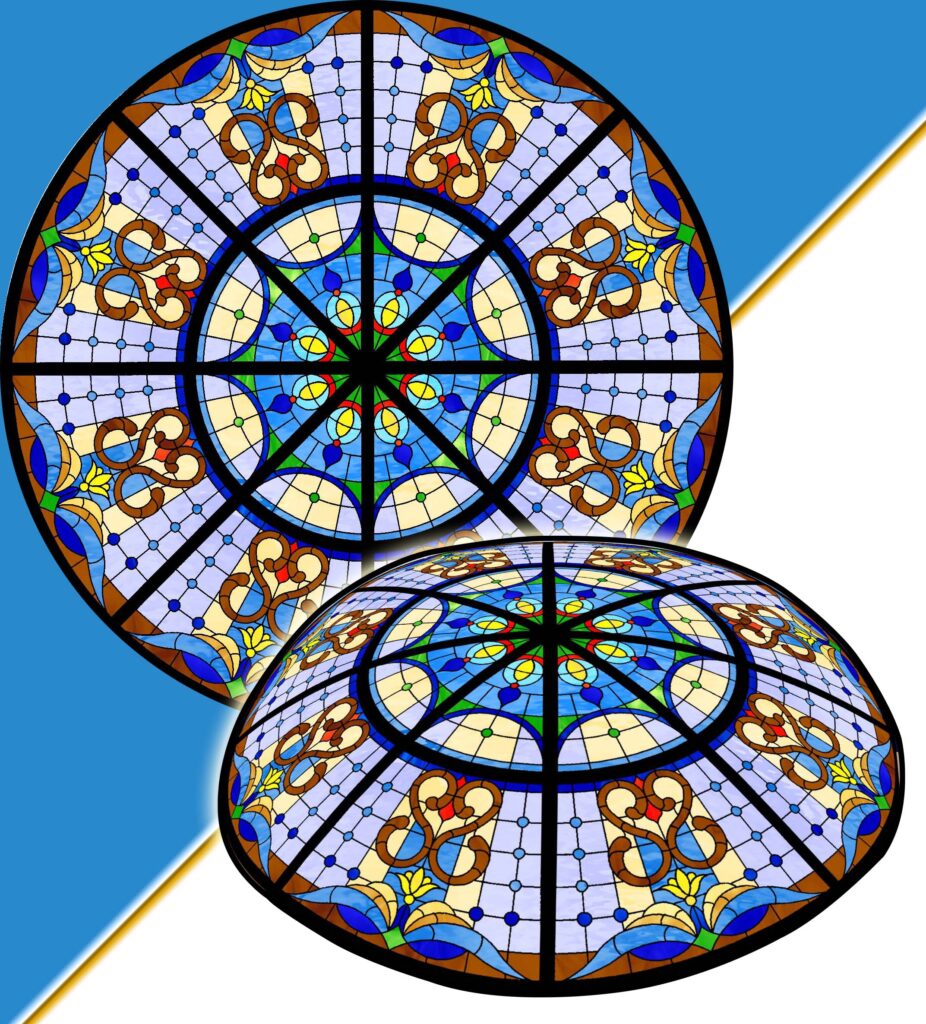
Stained glass domes are highly decorative domes, often found in churches, made from pieces of stained glass. The glass pieces are arranged in intricate patterns and held together by a framework of lead or metal. Stained glass domes can be used to create a beautiful focal point in a space, or to cast colored light on the interior.
The history of dome design dates back to ancient times, when domes were constructed for tombs, temples, and other religious structures. The first known domes were constructed in Mesopotamia around 4000 BC, and have been used in many cultures since then. In Ancient Rome, domes were used to cover baths, basilicas, and other public buildings, and in the Byzantine Empire, domes were used to cover churches. In the Renaissance, dome design was used to create grandiose churches, and in the Baroque period, domes were used to create highly ornate churches and palaces. In the 19th century, advancements in engineering allowed for the construction of large, reinforced concrete domes, which were used to construct sports stadiums, train stations, and other public buildings. Today, dome design is used in a variety of different structures, from churches to homes to stadiums
Four types of domes
1. Onion Dome: This is the most recognizable type of dome, it is a hemispherical dome that is typically found on top of a drum or cylinder.
Onion domes are a type of architectural feature that originated in Russia and are common in Eastern European and Central Asian countries, particularly in places with a strong Orthodox Christian influence. They are also found in some Islamic and Hindu countries, although less commonly.
2. Hemisphere Dome: This type of dome is also called a half-sphere. It is a true hemisphere and is usually made of concrete or other strong material.
Hemisphere domes are most commonly used in architecture, interior design, and landscape design. They are also used in entertainment, science, and education, as well as in historical and cultural references. Some popular applications include planetariums, aquariums, shopping malls, churches, mosques, and theaters.
3. Conical Dome: This dome is similar to an onion dome, but it is taller and has a more pointed shape.
Conical domes have been used in a variety of applications, from architectural structures to military fortifications. The most famous examples of conical domes include the Pantheon in Rome, the Great Mosque of Samarra in Iraq, and the Hagia Sophia in Istanbul. Other notable examples include the dome of the Taj Mahal in India, the dome of St. Peter’s Basilica in Vatican City, and the dome of the United States Capitol in Washington, D.C.
4. Barrel Dome: This dome is also like an onion dome, but it is shorter and wider, and it often has a rounded top.
Barrel domes are mostly constructed over swimming pools, spas, and other water features. They are also used as architectural accents on buildings, providing protection from the elements while creating a unique look.
Beautiful and Elegant Stained Glass Domes
Stained glass domes are beautiful, elegant pieces of art that can be used to add a unique focal point to any room. They can be used to create a variety of different interior designs, such as a regal look, a modern style, or an eclectic mix. Stained glass domes come in a variety of colors, shapes, and sizes, so you can choose the perfect one to fit your style. They can be used to create a unique light fixture or to add a touch of color and elegance to any space.
To cover a stained glass dome, you can use a light-filtering fabric such as a muslin or sheers, or you can use a light-diffusing plastic film. You can also cover it with a custom-made shade or a lampshade.